
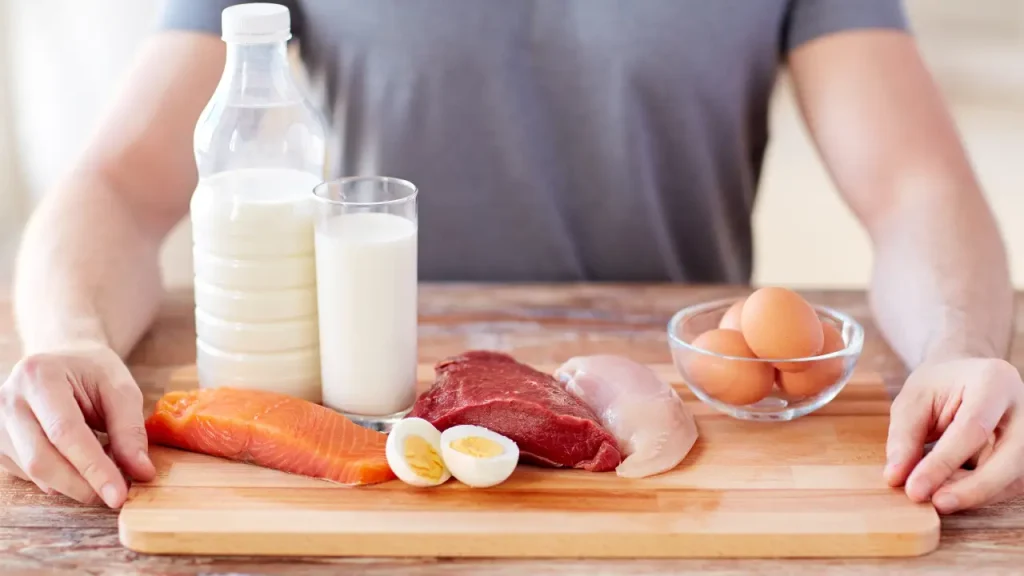
Getting your daily protein isn’t just a numbers game, it’s about quality and timing, too. Spreading your protein intake evenly across meals helps hold onto muscle mass, revs up your metabolism, and ensures your body recovers optimally.
Protein is the body’s workhorse. It’s made up of amino acids, which act as building blocks for your tissues, enzymes, hormones, and immune system.
As the Harvard T.H. Chan School of Public Health points out, your muscles need fuel, and that’s exactly where protein steps in. Your body breaks down the protein you eat into amino acids, which it then uses to build and repair muscle.
As men get older, maintaining muscle strength becomes even more critical. Sarcopenia, the natural loss of muscle mass due to aging, can kick in as early as your 30s and speed up over time, making protein intake more important than ever.
The Baseline Recommendation
For the average healthy guy who isn’t hitting the gym hard, the standard guideline is 0.8 grams of protein per kilogram of body weight per day (g/kg/day).
In plain English: if you weigh 70 kg (about 154 lbs), you’d need roughly 56 grams of protein a day. This number is based on the Recommended Dietary Allowance (RDA), which is essentially the minimum amount needed to keep a healthy person from becoming deficient. However, remember that this is just a baseline. It’s rarely the optimal amount, especially for active guys or older men.
When You Need More Fuel for Activity
If you work out regularly (especially lifting weights), are trying to pack on muscle, or want to lose fat without losing your gains, your protein needs go up.
- For active guys: Aim for 1.4 to 2.0 g/kg/day.
- For strength training: Some research suggests pushing that up to 1.6 to 2.2 g/kg/day.
While 0.8 g/kg keeps you alive, many experts believe that for better metabolism, muscle health, and recovery, you should aim higher—roughly 20–30% of your daily calories. A practical rule of thumb for most men is to shoot for at least 30 grams of protein at every meal.
Why Age Matters
As you age, your body gets a bit stubborn. It becomes less efficient at using the protein you eat to maintain muscle (a phenomenon known as “anabolic resistance”).
Because of this, studies suggest that older adults actually need more protein—somewhere between 1.0 to 1.6 g/kg/day—to keep their strength and muscle mass intact.
So, a 60-year-old man weighing 75 kg might aim for 90 grams (75 × 1.2) or more per day, depending on how active and healthy he is.
How Much Should You Eat Per Meal?
It’s not just about the daily total; it’s about how you spread it out.
To maximize muscle growth, try to hit around 0.4 g/kg per meal, spread across at least four meals (totaling about 1.6 g/kg/day).
For a 70 kg man, that’s roughly 28 grams per meal if eating four times a day. Generally speaking, aiming for 20–30 grams of high-quality protein per meal is a solid, easy-to-follow target for most people.
Practical Guide & Top Food Sources
Harvard experts recommend getting your protein from high-quality sources like lean poultry, fish, dairy, legumes, soy, nuts, and whole grains.
Here’s what that looks like on a plate:
- ±3½ oz (100 g) cooked lean chicken breast = ±31 g protein.
- ±3½ oz cooked salmon = ±24 g protein.
- 1 cup cooked beans = ±18 g protein.
Daily Eating Tips:
- Consistency is Key: Try to include a protein source at breakfast, lunch, and dinner. Add a snack if you’re falling short.
- Go Lean: Opt for lean meats or plant-based proteins to improve your overall diet (think less saturated fat, more fiber).
- Post-Workout Fuel: After a heavy lifting session, try to eat a meal or snack with quality protein (and some carbs) within 30 to 60 minutes to jumpstart recovery.
To hit these daily goals easily, make sure you’re choosing quality ingredients. A perfect option is Olagud Chicken Breast Fillet. It’s high in protein, low in fat, and completely free from “nasties” like antibiotics and growth hormones.
Since it absorbs marinades beautifully and has a tender texture, Olagud chicken breast is also an excellent post-workout meal to help your muscles recover. It’s a delicious, healthy, and lean way to keep your diet balanced every day.
Can You Have Too Little—or Too Much?
Protein is essential, but balance is key.
- Too Little: This is a real risk, especially for older men. Low protein intake can lead to muscle wasting, frailty, and trouble getting around.
- Too Much: For healthy guys with normal kidneys, higher intake (1.4–2.2 g/kg) is generally safe.
However, be careful: a high-protein diet that’s also full of fatty meats or processed foods can raise heart health risks. Plus, if you’re only eating protein, you might be missing out on other nutrient-dense foods. Focus on quality and balance.
The Bottom Line
Don’t just guess, strategize. Spread your protein intake out (e.g., 20–30 grams per meal), pick high-quality sources, and adjust your numbers based on your weight, age, and workout intensity.
For men, getting enough protein is the foundation of good health. It keeps your muscles strong, aids recovery, and keeps your metabolism humming. While the standard “0.8 g/kg” rule is a good starting point, most men will feel and perform better with a bit more.
Remember: When and how you eat protein is just as important as how much you eat.


